Why are some proven ideas hard to believe in? This New Yorker article explores the difficulty we have when the facts are counter-intuitive or against our beliefs, or simply when we are replacing an old idea with a new idea. A classic investment example is the persistent inclination to buy when markets are rising and sell when markets are falling, and a few moments thought will identify others that confront us and our clients . . . Click here.
Friday, August 24, 2012

Friday, June 15, 2012
3 Scams You Need to Know About
It’s one o’clock in the morning and your sleep is interrupted by a
phone call. Startled, you answer the phone and hear what sounds like your
grandson on the other end, saying he’s been in a bad car accident while on
vacation in a foreign country. While waiting for a tow company to come, he was
mugged. Now, he’s hurt and has no money. He desperately needs you to wire him a
few thousand dollars to get back home safely. He also asks you not to tell his
mom and dad, as he doesn’t want them to know about his dilemma.
This story is just one of many similar tales that phone scammers
use to target senior citizens. In what’s known as the “grandparent scam,”
crooks scare their elderly suspects with a call in the middle of the night,
catching them off guard with a heartbreaking story about someone they care
about. The “grandchild” is always in need of cash, which he or she instructs
the victim to wire through a money-transfer service, and repeatedly asks the
victim not to tell anyone.
A real and
growing threat
As the number of aging Americans continues to grow, more and more
scams are targeting people 60 and older, who are often perceived as more
trusting and polite. Based on their success with seniors, many con artists are
now attempting to defraud people of all ages with similar schemes. In 2010, the
Federal Trade Commission received 60,000 complaints about the grandparent scam
and related frauds; in 2011, the number of complaints increased by 22 percent,
to 73,281.
Besides the grandparent scam, those who prey on the elderly have
plenty of other tricks up their sleeves. For example:
2. Imposters pretend to be with a government
agency, such as the Social Security Administration, Internal Revenue Service,
or another trusted source, trying to convince their targets that, in order to
comply with new regulations, they must pay exorbitant sums for unneeded
products and services.
3. Claiming to represent Wal-Mart or another well-known company, scammers inform their targets that they’ve won a sweepstakes and need to make a payment to obtain the supposed prize. They may even send fake prize-money checks to their victims’ homes. But before the checks bounce, the criminals collect money for “fees.”
How can you protect yourself and older family members?
To safeguard your identity and finances from con artists, keep these tips in mind:
• Never wire or send money to someone you don’t know, no matter what the circumstances may be or how convincing the person is. As with sending cash, once you wire money, you cannot get it back. Also remember that legal sweepstakes don’t require you to pay taxes or other fees in order to claim your winnings.
• Don’t forget your common sense, especially in the middle of the night. Fraudsters call at times when they think they can catch you off guard, shock you, and cause you to panic. They also create a sense of urgency, pressuring you to send them money before you find out who they really are. As disturbing as the call may be, remember to keep calm and rely on your common sense.
• Question the caller. If someone contacts you claiming to be a family member, friend, or someone else you know, ask the caller questions to confirm his or her identity. You could quiz him or her on the date of a family’s member birthday, the name of a pet, or the restaurant you last went to together.
• Confirm the emergency situation. To determine if the story is real, call sources who can verify where the person in question is. If someone calls claiming to be your grandchild, contact your actual grandchild’s parents immediately, no matter how many times the caller asks you not to say anything to anyone.
• Be wary of strange messages. Usually, these scams don’t involve meeting anyone personally; rather, the scammers will keep their distance, contacting you by phone, letter, fax, e-mail, or even text message.
• Know that scammers don’t always ask for sizable amounts of cash. In most cases, it’s between $500 and $5,000. If you wire money once, the scammer may continue to contact you in the hope that you’ll keep sending money, upping the requested amounts until the total takeaway is far greater.
• Protect your computer, tablet, and smartphone information. Don’t let crooks get their hands on your e-mail account, phone contacts, or passwords stored on your electronic devices. To protect yourself, label the phone numbers of family members by their first name, rather than “Mom,” “Grandpa,” and so on.
• Contact your local law enforcement department if you’re concerned that a con artist is targeting you.
Remember, scams are ever-changing, and fraudsters are constantly coming up with new ways to take advantage of unsuspecting victims. To stay up to date on the latest scam alerts, visit the FTC’s website at www.ftc.gov/bcp/edu/microsites/phonefraud/index.shtml.
How can you protect yourself and older family members?
To safeguard your identity and finances from con artists, keep these tips in mind:
• Never wire or send money to someone you don’t know, no matter what the circumstances may be or how convincing the person is. As with sending cash, once you wire money, you cannot get it back. Also remember that legal sweepstakes don’t require you to pay taxes or other fees in order to claim your winnings.
• Don’t forget your common sense, especially in the middle of the night. Fraudsters call at times when they think they can catch you off guard, shock you, and cause you to panic. They also create a sense of urgency, pressuring you to send them money before you find out who they really are. As disturbing as the call may be, remember to keep calm and rely on your common sense.
• Question the caller. If someone contacts you claiming to be a family member, friend, or someone else you know, ask the caller questions to confirm his or her identity. You could quiz him or her on the date of a family’s member birthday, the name of a pet, or the restaurant you last went to together.
• Confirm the emergency situation. To determine if the story is real, call sources who can verify where the person in question is. If someone calls claiming to be your grandchild, contact your actual grandchild’s parents immediately, no matter how many times the caller asks you not to say anything to anyone.
• Be wary of strange messages. Usually, these scams don’t involve meeting anyone personally; rather, the scammers will keep their distance, contacting you by phone, letter, fax, e-mail, or even text message.
• Know that scammers don’t always ask for sizable amounts of cash. In most cases, it’s between $500 and $5,000. If you wire money once, the scammer may continue to contact you in the hope that you’ll keep sending money, upping the requested amounts until the total takeaway is far greater.
• Protect your computer, tablet, and smartphone information. Don’t let crooks get their hands on your e-mail account, phone contacts, or passwords stored on your electronic devices. To protect yourself, label the phone numbers of family members by their first name, rather than “Mom,” “Grandpa,” and so on.
• Contact your local law enforcement department if you’re concerned that a con artist is targeting you.
Remember, scams are ever-changing, and fraudsters are constantly coming up with new ways to take advantage of unsuspecting victims. To stay up to date on the latest scam alerts, visit the FTC’s website at www.ftc.gov/bcp/edu/microsites/phonefraud/index.shtml.
Wednesday, June 13, 2012
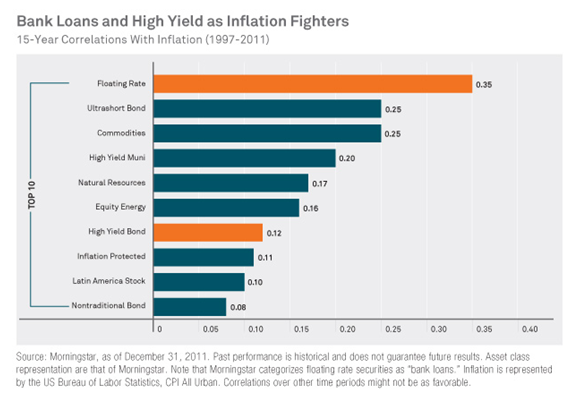
What Might Work Against Inflation?
To combat the erosion of purchasing power, floating rate securities and high yield could be considered as investment options. Both asset classes have had historically high correlations with inflation compared to other asset classes. Out of 80+ Morningstar Asset Class categories, the below chart depicts the 10 most effective inflation fighters, as ranked by 15-year correlations.
Monday, June 11, 2012
Quote/Graph of the Week:
Thanks to Jim
McAllister and the rest of the Equity Research team at Commonwealth Financial Network
I have this to offer:
In a week when
the GDP report showed a weaker-than-expected U.S. economy while corporate
earnings came in better than anticipated, many investors have been left
wondering how to explain the disconnect between the two data points. The
accompanying graph, which illustrates the share of corporate profits derived
from foreign markets over the last 65 years, may hold the answer.
U.S. companies now earn almost a quarter of their overall
profits overseas. As globalization continues—and the Chinese consumer, in particular,
continues to have more disposable income—we expect this trend to continue.
Apple’s incredible earnings results are a perfect example of how foreign sales
can be such a strong driver of growth. Up until the last several quarters,
China was a minimal part of Apple’s overall revenue and profits. The country
now represents about 20 percent of Apple’s revenues. That number will only grow
as the company expands its distribution footprint and the number of products it
sells in China.

Thursday, June 7, 2012
How Have The Numbers Changed?
NET WORTH - The total net worth of U.S residents
was $58.5 trillion as of 12/31/11, down 0.6% in the last year (source: Federal
Reserve). This suggests that the average
net worth per person in the U.S is ~$188,000. This is, in itself not
meaningful as the poorest 40% of U.S
households collectively have virtually no net worth, thus skewing the
“wealth distribution curve” sharply.
BIG DEBT - The total value of home mortgage debt
(including home equity loans) held by Americans has decreased 7% in the last 4
years. The amount owed nationwide is $9.8 trillion (source: Federal Reserve).
As only ~65% of U.S residents own the
home they live in and only about half carry mortgages this suggests that all of this mortgage debt is carried by
~32% of families (~40 million households) in the U.S. leaving households that have a mortgage with a
mortgage balance averaging ~$245,000.
MORE PROFITS – Over
the past 10 years the companies in the S&P 500 have seen their profits
increase ten times faster than their stock price. Surely not overpriced in
January 2002, stock pricing is a function of a firms current and future
profitability filtered through marked Aggregate (sum total) earnings per share of the companies in the
S&P 500 stock index have grown +13% per year on average over the last 10
years (2002-2011), increasing by +253% in aggregate over the decade (source:
S&P). While average trading volume has nearly tripled in the past 10
years, and while January 2002 stock pricing reflected a ~24% drop from March
2000 highs, the year end 2011 closing
price of the S&P 500 index (~1,267) reflects a stock price increase of
~1.2% per year average over the last 10 years (2002-2011), increasing by ~13%
in aggregate over the decade.
Friday, June 1, 2012
Who (at the IRS) Loves Ya Baby?
In the 1990s the Senate was holding hearings as a public
forum as theater to “beat” the IRS for what was seen as unconscionable auditing
and poor taxpayer service. This led to the passage of the Internal Revenue
Service Restructuring and Reform Act of 1998….Big yawn, you say??
Well, this piece of legislation called for the formation of
the Taxpayer Advocate Service. It was begun in 2000 with the hiring of Nina
Olsen as its first (and only) director. This agency is part of the IRS and is
working for us… go figure!
I want to share with you a heartwarming story, inspirational,
one that may give you hope for the
humanity of the IRS, well, at least for this band of “Advocates” working for
Ms. Olsen – and for us. Like a disciplined group of Robin Hoods Merry Men, they
are helping to make what too often seems insanely wrong a bit more right.
Please consider forwarding this post to your CPA/EA and to
all of your friends – a bit of hopefulness. Perhaps we should each send a Thank
You card, a bundt cake, you know, to Ms. Olsen, encourage her to keep up the
good work and let her know that we support her group.
What do you think?
Comment below…
Wednesday, May 30, 2012
Addiction to Prediction?

While I recommend the full article you may find the conclusion a most
helpful summary:
Question Authority
Prediction should be all
about risk, uncertainty, and likelihood, but what you’ll hear this week and
throughout the year is a chorus of experts telling you with great certainty
what the future will bring. Don’t believe them. If you’re jonesing for advice, try
listening to those who are providing detail on probability, risk and trends.
But know that the future is never about certainty and always about probability.
When prognosticators get it right, they were just plain lucky. They may have
played the odds. They may have had some truly intuitive insight that others did
not. But there is never a sure thing.
Subscribe to:
Posts (Atom)