Friday, September 28, 2012

So How Good An “Investment” is That Long Term Care Policy?

Remembering that we hope to live a long life and never really need the benefit of the coverage it is still a fantastic risk management tool. In recent years we have seen insurance companies either discontinue offering new applicants coverage or offer it at significantly higher rates. In a nutshell, the product appears to have been underpriced – and quite likely may still be.

Partly due to improved longevity, and partly due to low return on investments (principally bonds) that insurance companies expect, another Long Term Care insurer has announced another price adjustments to its long-term care product. These changes affect only new applicants and not existing policy holders. This has been a common trend among Long Term Care insurers and the below changes being made by one major insurer are quite typical of what we see from others.

For this insurer the following changes will take effect on September 25, 2012 in all but 15 states (expect the changes to be rolled out in the remaining 15 states in a matter of months):
  • A 15-percent increase on all premium rates (new business only)
  • Preferred health discount, applicable to single applicants, reduced from 15 percent to 10 percent (This discount is already 10 percent for couples, and that rate will not change.)
  • Couples discount reduced:
     
    • Both spouses approved: Discount will be 20 percent instead of 30 percent
    • Married spouse not applying: Discount will be 10 percent instead of 15 percent
Additional changes— On September 25, the following changes will take effect in all states except New York:
  • Sale of limited pay options (i.e., single-pay, 10-pay, and pay-to-65) suspended
  • Sale of the lifetime (unlimited) benefit period suspended
The theme here is higher pricing by as much as 31% through premium increases and the reduction in discounts as well as more restrictive coverage and payment options. This price increase is on top of the higher cost that one might expect to pay by delaying to begin coverage for one or more years.

So, congratulate yourself for putting coverage in place for yourself, look more favorably upon your now relatively modest rate for that existing coverage, and advocate coverage to your friends and family – especially those with less than $3,000,000 in invested assets whom you may become the caregiver too if/when they need care.

Wednesday, September 26, 2012

Understanding The Fiscal Cliff

With the upcoming elections and looming effects of the fiscal cliff individuals need to have resources to understand what lies ahead. The article below has summarized the most comprehensive and efficient websites for that very information. If you would like to be well informed about how this will impact your finances read on.  
*Mark Phillips and Associates does not provide legal or tax advice. You should consult a legal or tax professional regarding your individual situation.

Monday, September 17, 2012

Making Good Decisions

Making Good Decisions

July 19, 2012

       
Make good financial decisions can be hard when you see people making bad decisions being rewarded.


Process of Making a Decision
It can be really hard to behave correctly if we see examples of people being successful while doing things we know have higher odds of a bad outcome (e.g., buying lottery tickets). But as you’ve probably learned by now, investing isn’t always fair. Bad choices get rewarded, while people who made prudent decisions sometimes appear to be punished—at least in the short run.

So even though it’s tempting, I strongly encourage you to judge the investment advice you receive based on the validity of the principle and not the outcome. For instance, one story I shared in The Behavior Gap dealt with a client who had stock in his grandmother’s mining company. Over time, the family had invested and lost millions trying to keep the business afloat. As you might imagine, the family stories around the business made it seem like a sacred thing to protect, regardless of the cost.

At this point, the stock had reached a low of $2 a share, and my client debated what to do. He worried that if he sold the stock, then it might recover and his family would regret the sale and wish they’d kept it. I acknowledged that if he sold the stock and it doubled or tripled—which was a real possibility—he’d feel badly. But the catch was that if he kept the stock and it went to zero, he’d feel much, much worse.

The underlying factor was that he needed to make a decision based on a principle (e.g., did owning this stock support his long-term goals) instead of the emotion and family lore surrounding the stock. There’s no guarantee that good investment decisions won’t lead to a painful result. But we need to remain committed to making good decisions based on sound principles and not just luck.

Carl

Wednesday, September 5, 2012

Why We're driven to trade

With computerized traders that "hold" stocks for only a few seconds at a time and markets that can swing wildly in a matter of moments, long-term investing seems to be on the verge of extinction.

Perhaps this is inevitable. It turns out that short-term thinking is deeply embedded in the workings of the human brain. New research suggests that in order to avoid trading your accounts to death, you must counteract some of the very tendencies that make Homo sapiens the most intelligent of all species.

Friday, August 24, 2012

Why We Don't Believe in Science

Why are some proven ideas hard to believe in? This New Yorker article explores the difficulty we have when the facts are counter-intuitive or against our beliefs, or simply when we are replacing an old idea with a new idea. A classic investment example is the persistent inclination to buy when markets are rising and sell when markets are falling, and a few moments thought will identify others that confront us and our clients . . . Click here.

Friday, June 15, 2012

3 Scams You Need to Know About

It’s one o’clock in the morning and your sleep is interrupted by a phone call. Startled, you answer the phone and hear what sounds like your grandson on the other end, saying he’s been in a bad car accident while on vacation in a foreign country. While waiting for a tow company to come, he was mugged. Now, he’s hurt and has no money. He desperately needs you to wire him a few thousand dollars to get back home safely. He also asks you not to tell his mom and dad, as he doesn’t want them to know about his dilemma.

This story is just one of many similar tales that phone scammers use to target senior citizens. In what’s known as the “grandparent scam,” crooks scare their elderly suspects with a call in the middle of the night, catching them off guard with a heartbreaking story about someone they care about. The “grandchild” is always in need of cash, which he or she instructs the victim to wire through a money-transfer service, and repeatedly asks the victim not to tell anyone.

A real and growing threat

As the number of aging Americans continues to grow, more and more scams are targeting people 60 and older, who are often perceived as more trusting and polite. Based on their success with seniors, many con artists are now attempting to defraud people of all ages with similar schemes. In 2010, the Federal Trade Commission received 60,000 complaints about the grandparent scam and related frauds; in 2011, the number of complaints increased by 22 percent, to 73,281.

Besides the grandparent scam, those who prey on the elderly have plenty of other tricks up their sleeves. For example: 

1.  Scammers posing as telemarketers ask for donations to civic causes, attempting to appeal to the older generation’s patriotism and respect for authority.

2.  Imposters pretend to be with a government agency, such as the Social Security Administration, Internal Revenue Service, or another trusted source, trying to convince their targets that, in order to comply with new regulations, they must pay exorbitant sums for unneeded products and services.

3.  Claiming to represent Wal-Mart or another well-known company, scammers inform their targets that they’ve won a sweepstakes and need to make a payment to obtain the supposed prize. They may even send fake prize-money checks to their victims’ homes. But before the checks bounce, the criminals collect money for “fees.”

How can you protect yourself and older family members?

To safeguard your identity and finances from con artists, keep these tips in mind:


• Never wire or send money to someone you don’t know, no matter what the circumstances may be or how convincing the person is. As with sending cash, once you wire money, you cannot get it back. Also remember that legal sweepstakes don’t require you to pay taxes or other fees in order to claim your winnings.

• Don’t forget your common sense, especially in the middle of the night. Fraudsters call at times when they think they can catch you off guard, shock you, and cause you to panic. They also create a sense of urgency, pressuring you to send them money before you find out who they really are. As disturbing as the call may be, remember to keep calm and rely on your common sense.

• Question the caller. If someone contacts you claiming to be a family member, friend, or someone else you know, ask the caller questions to confirm his or her identity. You could quiz him or her on the date of a family’s member birthday, the name of a pet, or the restaurant you last went to together.

• Confirm the emergency situation. To determine if the story is real, call sources who can verify where the person in question is. If someone calls claiming to be your grandchild, contact your actual grandchild’s parents immediately, no matter how many times the caller asks you not to say anything to anyone.

• Be wary of strange messages. Usually, these scams don’t involve meeting anyone personally; rather, the scammers will keep their distance, contacting you by phone, letter, fax, e-mail, or even text message.

• Know that scammers don’t always ask for sizable amounts of cash. In most cases, it’s between $500 and $5,000. If you wire money once, the scammer may continue to contact you in the hope that you’ll keep sending money, upping the requested amounts until the total takeaway is far greater.

• Protect your computer, tablet, and smartphone information. Don’t let crooks get their hands on your e-mail account, phone contacts, or passwords stored on your electronic devices. To protect yourself, label the phone numbers of family members by their first name, rather than “Mom,” “Grandpa,” and so on.

• Contact your local law enforcement department if you’re concerned that a con artist is targeting you.


Remember, scams are ever-changing, and fraudsters are constantly coming up with new ways to take advantage of unsuspecting victims. To stay up to date on the latest scam alerts, visit the FTC’s website at www.ftc.gov/bcp/edu/microsites/phonefraud/index.shtml.

Wednesday, June 13, 2012

What Might Work Against Inflation?


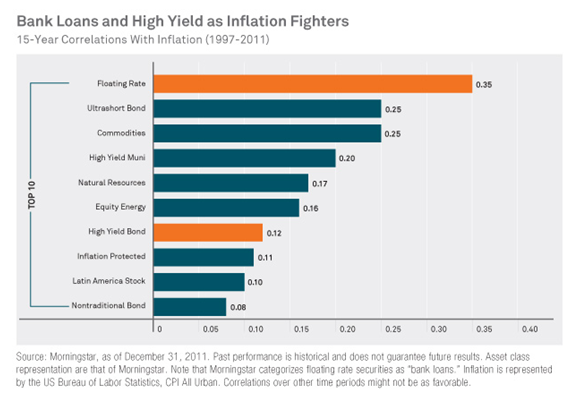
To combat the erosion of purchasing power,   floating rate securities and high yield could be considered as investment options. Both asset classes have had historically high correlations with inflation compared to other asset classes. Out of 80+ Morningstar Asset Class categories, the below chart depicts the 10 most effective inflation fighters, as ranked by 15-year correlations.